
If you have had your home or auto insurance with Safeco, you may have noticed a significant change: Safeco is now Liberty Mutual.
Naturally, that has longtime Safeco customers asking questions.
- Did my insurance actually change?
- Should I stay with Liberty Mutual?
- Should I shop around?
- Could another insurance company offer me a better rate?
- What happens if I decide to switch?
All fair questions.
As an independent insurance agency, we think a change like this is a reasonable moment to review your insurance. But one thing should be clear from the start: the Safeco-to-Liberty Mutual change does not, by itself, mean you should switch insurance companies.
For some people, staying exactly where they are is the right call. For others, comparing the market uncovers something worth acting on.
So — stay, switch, or at least shop? Let’s walk through it.
What actually happened to Safeco Insurance?
There is a common misconception worth clearing up first.
Liberty Mutual did not recently purchase Safeco. Liberty Mutual acquired Safeco in 2008. For years afterward, Safeco continued operating as its own brand, particularly through the independent agent channel.
In April 2026, Liberty Mutual retired the Safeco brand and began marketing and selling those personal insurance products under the Liberty Mutual name. Safeco had grown to roughly $14 billion in annual premium across 48 states, distributed through more than 22,000 independent agencies.
So if you were a Safeco customer and now see Liberty Mutual on your documents, this is a brand transition, not a new acquisition.
According to Liberty Mutual, existing Safeco customers kept their agent relationships, and policies were not impacted simply because of the name change.
Seeing a different name on your insurance is not, by itself, a reason to leave. But it may prompt a bigger question:
Is what I have still the best option for me?
That question is worth answering.
Option 1: Stay with Liberty Mutual
You can stay right where you are.
Nothing about this transition requires you to switch. If you are happy with your coverage, comfortable with what you pay, satisfied with your agent, and confident the policy still fits your life, staying may make perfect sense.
We also do not recommend switching simply because someone puts a lower number in front of you. A cheaper quote is not automatically a better policy.
Before moving, understand what you are actually getting. Compare:
- Liability limits
- Home replacement cost and dwelling limit
- Deductibles
- How roof losses are settled
- Water and sewer backup coverage
- Auto liability limits
- Uninsured and underinsured motorist coverage
- Comprehensive and collision deductibles
- Rental reimbursement
- Umbrella coverage
- Discounts, endorsements, and optional coverages
If another company saves you a few hundred dollars but leaves you with meaningfully less protection, that is not a good trade.
Sometimes staying really is the right decision, and a good agent should be willing to tell you so.
Option 2: Stay with Liberty Mutual, but review your coverage
There is a middle path between doing nothing and switching: review what you already have.
Your life probably is not identical to when you first bought these policies. Maybe you have:
- Added or removed a vehicle
- Added a teenage driver
- Renovated your home or replaced the roof
- Purchased expensive personal property
- Increased your income or assets
- Changed jobs or driving habits
- Paid off a vehicle
- Added a pool or detached structure
Your insurance should change as your life changes.
So even if you have no intention of leaving, this is a reasonable moment to ask: What are my deductibles? Are my liability limits still appropriate? How much is my home insured for? What is not covered? Which discounts am I actually receiving? Are there gaps I do not know about?
You may finish that review feeling confident about staying exactly where you are. That is a good outcome.
Option 3: Compare your home and auto insurance
This is where an independent agency can be useful. Rather than being limited to one insurance company, an independent agency can compare several and ask which one fits your particular household best.
Sometimes the differences are substantial — and not only in price.
A real comparison: better coverage and $2,780 less per year
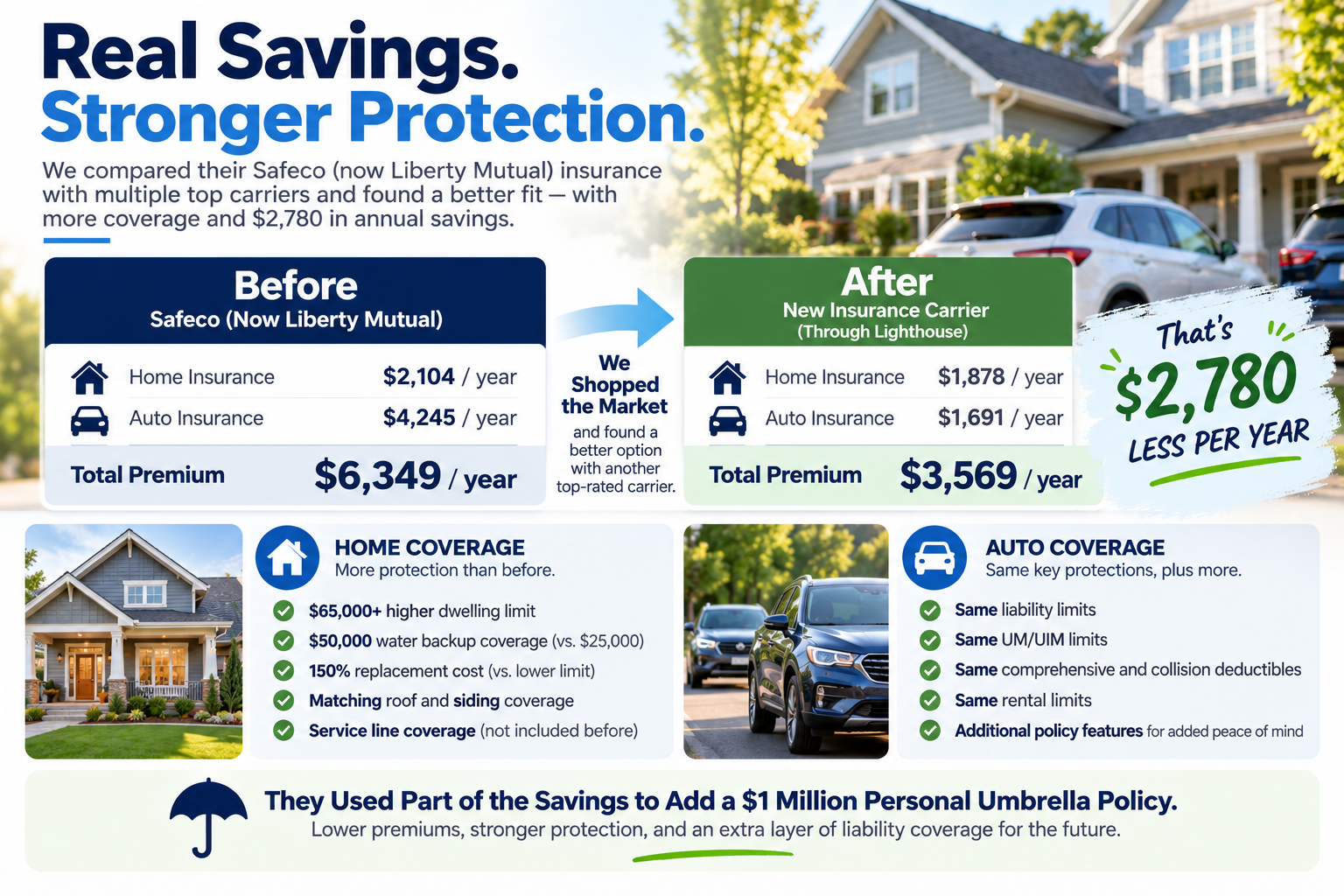
Here is a recent example from our agency. We are sharing the actual numbers because the coverage detail matters more than the savings figure.
This client had home and auto insurance with Safeco. They were paying $6,349 per year. After we compared the companies available through our agency, their new total for the same two policies was $3,569 per year — a difference of $2,780.
And the lower premium did not come from simply stripping away coverage. Here is what actually changed.
Home insurance: more coverage, lower premium
| Coverage | Before | After |
|---|---|---|
| Dwelling | $399,800 | $465,160 |
| Other Structures | $39,980 | $46,516 |
| Personal Property | $299,885 | $348,870 |
| Loss of Use | $79,960 | $139,548 |
| Personal Liability | $500,000 | $500,000 |
| Medical Payments to Others | $10,000 | $5,000 |
| Deductible | $2,500 | $2,500 |
| Water Backup | $25,000 | $50,000 |
| Annual premium | $2,104 | $1,878 |
The new policy also added coverages the previous one did not include at all, including matching roof coverage ($10,000), matching siding coverage ($20,000), service line coverage ($10,000), and replacement cost on personal property without depreciation.
The most significant difference does not appear on the limits page.
The previous policy included extended dwelling coverage up to 25% above the limit — roughly $499,750 available in a total loss. The new policy provides 150% replacement cost — roughly $697,740.
That is close to $198,000 in additional rebuild capacity in exactly the scenario homeowners insurance exists for.
It is also worth noting that the dwelling limit itself rose by more than $65,000. If the new replacement cost estimate is the accurate one, the previous policy was carrying less dwelling coverage than the home would actually cost to rebuild.
Two coverages on the home policy did decrease, and we mention them because a comparison that only lists wins is not a real comparison.
Medical payments to others went from $10,000 to $5,000. This is the coverage that pays for minor injuries to a guest on your property regardless of fault. It can be increased for a small premium if the client prefers. (Medical payments on the auto policy did not change — those stayed at $10,000 per person.)
Loss assessment coverage went from $5,000 to $2,000. This coverage responds when a homeowners or condo association levies an assessment against unit owners after a covered loss. This client’s property is not in an association, so the lower limit has no practical effect on their exposure.
That second one illustrates something worth saying directly: matching limits line for line is not the goal. The goal is making sure the coverages you actually need are adequate. Paying for a higher loss assessment limit on a property with no association is paying for something that cannot be used.
Auto insurance: identical limits, lower premium
This is the part people find hardest to believe, so here are the limits side by side. Three vehicles, same coverage on each.
| Coverage | Before | After |
|---|---|---|
| Bodily Injury Liability | $250,000 / $500,000 | $250,000 / $500,000 |
| Property Damage Liability | $100,000 | $100,000 |
| Medical Payments | $10,000 | $10,000 |
| Uninsured / Underinsured Motorist | $250,000 / $500,000 | $250,000 / $500,000 |
| Comprehensive deductible | $250 | $250 |
| Collision deductible | $500 | $500 |
| Rental reimbursement | $50 per day / $1,500 | $50 per day / $1,500 |
| Annual premium | $4,245 | $1,691 |
Not one limit was reduced. The new policy also added custom equipment coverage, roadside assistance with trip interruption, a vanishing deductible that credits $100 per year, total loss deductible waiver, accident forgiveness, and minor violation forgiveness.
And the $4,245 was not an undiscounted rate. It already reflected more than $1,400 in discounts and safe driving rewards.
The comparison result
| Before | After | Difference | |
|---|---|---|---|
| Home | $2,104 | $1,878 | −$226 |
| Auto | $4,245 | $1,691 | −$2,554 |
| Total | $6,349 | $3,569 | −$2,780 |
More home coverage. Identical auto limits. $2,780 less per year.
What they chose to do with the savings
Once the comparison was done, we showed this client something their previous program did not include: a personal umbrella policy.
They chose to add a $1,000,000 personal umbrella policy for $777 per year — and importantly, one that includes uninsured and underinsured motorist coverage.
That last part deserves emphasis, because umbrella UM/UIM is not automatic. Many umbrella policies exclude it or charge separately, and plenty of people carry an umbrella without realizing it does not extend to being hit by an uninsured or underinsured driver.
Previously, their own underinsured motorist protection was limited to the $250,000 per-person limit on the underlying auto policy. With the new umbrella’s UM/UIM coverage, they now have an additional layer of protection above the underlying policy, subject to the terms and conditions of both policies.
They were not required to buy it. They chose to, using roughly a quarter of what they had just saved — and they still pay about $2,000 a year less than before.
We are not saying you will save $2,780. Your situation could be entirely different. You might save more. You might save less. You might compare several companies and find your existing policy is still your best option.
That is the point of comparing. You do not know until you look.
Why can two insurance companies price the same household so differently?
This surprises a lot of people. How can two companies look at the same house, the same vehicles, and the same drivers and arrive at dramatically different premiums?
Because insurance companies do not price risk the same way. Each has its own rating methodology, underwriting guidelines, discount structure, claims experience, and appetite for particular homes, vehicles, and drivers.
One company may be very competitive for your household while another is not. And that changes over time. The company that was an excellent fit three or four years ago may still be — or may not be.
There is no single company that is automatically best for everyone. The better question is which company fits your situation right now.
Does this mean Liberty Mutual is too expensive?
No.
One client’s experience does not prove Liberty Mutual is expensive, and it does not mean every former Safeco customer should switch.
We want to be transparent: our agency does not currently represent Liberty Mutual for personal insurance.
We can compare the companies available through our agency against what you are paying now and help you understand the differences. We are not going to tell you Liberty Mutual is automatically a bad option simply because we do not represent them.
If another company offers a compelling combination of coverage, price, and service, switching may make sense. If we compare and your current policy still looks good, keeping it may be the right decision.
Our goal is not to convince you to switch. It is to help you see your options clearly.
When is it worth comparing your insurance?
You do not need to shop your insurance every few months. But it can make sense if:
- Your premium increased significantly
- Your renewal is approaching
- You added a teenage driver
- You bought a home
- You purchased or replaced vehicles
- Your household changed
- You made major improvements to your home
- You have not reviewed your policies in several years
- You are unsure whether your coverage is still appropriate
- You simply want to know whether your price is competitive
And if you are a former Safeco customer, the name change may be the thing that prompts the question. That is fine.
Shopping does not obligate you to switch. It gives you information.
Compare more than the price
This may be the most important part of the whole conversation.
If someone tells you they can save you $1,000, your next question should be: am I getting the same coverage?
Put the policies side by side. On the home policy, check the dwelling limit, the deductible, how the roof is settled, water backup, personal property, and liability. On the auto policy, check liability limits, uninsured and underinsured motorist coverage, comprehensive and collision deductibles, and rental reimbursement.
Get as close to apples-to-apples as you can. Because there is a real difference between:
“We lowered your premium.”
and
“We lowered your premium by reducing your protection.”
Those are not the same accomplishment.
What if you compare and do not save money?
Then you stay where you are — and that is not a failed review.
Imagine you are wondering whether you are overpaying. We compare the companies available to us and find your existing coverage and pricing are hard to beat. Now you know, and you go into your next renewal with more confidence.
Comparing sometimes reveals a better option. Sometimes it confirms the decision you already made. Both are useful.
So should you stay with Liberty Mutual or switch?
There is no single answer for every former Safeco customer. You have three reasonable choices:
- Stay with Liberty Mutual. If you are satisfied with your price, coverage, agent, and experience, you may have no reason to move.
- Stay, but review your policies. Make sure your insurance reflects your life today and that you understand what you are paying for.
- Compare your insurance. Have an independent agency put your current home and auto coverage next to other available companies.
What we would not recommend is switching solely because the name on the policy changed. We also would not recommend staying solely because you have been with the same company a long time.
Get the information. Compare. Then decide.
Frequently asked questions
Did Liberty Mutual just buy Safeco?
No. Liberty Mutual acquired Safeco in 2008. What happened in April 2026 was the retirement of the Safeco brand name, with those personal insurance products now marketed and sold under the Liberty Mutual name.
Did my policy change when Safeco became Liberty Mutual?
According to Liberty Mutual, existing Safeco customers kept their agent relationships and their policies were not impacted simply because of the name change. If you have specific questions about your policy, your declarations page and your agent are the authoritative sources.
Do I have to switch insurance companies now that Safeco is Liberty Mutual?
No. The brand change by itself is not a reason to leave. It may be a reasonable prompt to review your coverage, but staying is a legitimate choice.
Should I switch if another company quotes me a lower price?
Not automatically. A lower premium is only meaningful if the coverage is comparable. Compare dwelling limits, deductibles, roof settlement, liability limits, and uninsured and underinsured motorist coverage before deciding.
Can an independent agency really save me money?
Sometimes, and sometimes not. An independent agency can compare multiple companies rather than one, which increases the chance of finding a better fit. But there is no guarantee, and in some cases the existing policy turns out to be the better option.
How much could I save by shopping my insurance?
There is no typical figure, and anyone who promises one should be treated with skepticism. One recent client of ours reduced their home and auto premium from $6,349 to $3,569 — a difference of $2,780 — while improving their home coverage and keeping identical auto limits. They later chose to add a $1,000,000 umbrella policy with part of the savings. Your result could be very different in either direction.
What is a personal umbrella policy?
It is additional liability coverage that sits above the limits on your home and auto policies. If a claim exceeds your underlying liability limits, the umbrella responds. Whether an umbrella also covers you for being hit by an uninsured or underinsured driver is worth asking specifically, because not every umbrella includes that.
Will shopping my insurance hurt my credit?
Insurance quoting generally uses a soft inquiry for insurance scoring purposes, which does not affect your credit score the way a loan application would. Practices can vary by company, so it is reasonable to ask before you provide information.
Does getting a quote mean I have to switch?
No. Requesting a comparison gives you information. You are free to stay where you are.
What should I compare besides price?
Dwelling limit and replacement cost provisions, deductibles, how roof losses are settled, water backup, personal property, liability limits, uninsured and underinsured motorist coverage, comprehensive and collision deductibles, rental reimbursement, and available discounts. A nearly identical premium can sit on top of meaningfully different coverage.
What is extended or additional replacement cost on a home policy?
It is an additional cushion above your dwelling limit that becomes available if rebuilding costs more than the policy limit. It is usually expressed as a percentage — for example, 25% above the limit, or 150% of the limit. It matters most after widespread events when construction costs spike.
What is underinsured motorist coverage and do I need it?
It responds when an at-fault driver’s liability limits are not enough to cover your damages. Given how many drivers carry minimum limits, it is one of the more frequently relevant coverages on an auto policy. Ohio drivers should understand what limits they carry.
When should I review my insurance?
At minimum when something changes — a new vehicle, a new driver, a home purchase, a renovation, a significant premium increase — or if it has simply been several years since anyone looked at it closely.
Know your options
Safeco becoming Liberty Mutual has given some people a reason to think about their insurance again. That can be a good thing.
If you are wondering whether there is another option, you do not have to guess.
Start a quote or contact our team and we will compare your current home and auto coverage against the companies we represent — limits, deductibles, and endorsements, not just the premium — so you can see the differences clearly and decide for yourself.
You may also want to review our homeowners insurance and auto insurance pages, or browse our personal insurance FAQ.
Lighthouse Agency Insurance
Licensed in Ohio, Indiana, Kentucky, and Tennessee | Serving Fairfield, Hamilton, West Chester, Butler County, and Greater Cincinnati
This blog provides general educational information and does not constitute insurance advice or legal counsel. Your insurance coverage is determined by your policy document. Premiums, coverages, discounts, and eligibility vary by insurer, policy form, property, vehicle, driver, and state, and the savings described reflect one client’s specific circumstances rather than a typical or expected result. For questions about your specific coverage or claims, contact your insurance agent or company directly.